Point it at any document collection. See who's being ignored. See who's coordinating. See what's being suppressed.
Traditional information retrieval systems focus on finding relevant documents. Aegis Insight takes a fundamentally different approach: it extracts structured knowledge from unstructured text, builds a queryable graph of claims and entities, and provides analytical tools to examine the shape and structure of knowledge itself. It shows you who cites whom, who ignores whom, and where consensus may be manufactured versus earned. Runs locally on gaming-class hardware. No cloud. No middlemen. Validates against settled historical data sets for verifiable performance.
Standard retrieval systems answer "what do sources say about X?" Epistemic topology mapping answers a different question entirely: "what's the structure of who says what, and who ignores whom?"
| What You Ask | Standard RAG | Epistemic Topology |
|---|---|---|
| "What do sources say about X?" | Retrieves relevant chunks | Retrieves + shows citation topology |
| "Can I trust this?" | Trust by recency or authority | Trust by network position, credential-claim alignment |
| "What's the consensus?" | Synthesizes apparent agreement | Exposes whether consensus is earned or manufactured |
| "Why don't I see this elsewhere?" | Cannot answer | Detects citation voids, suppression patterns |
See citation flow, not just content. Understand who references whom, who ignores whom, and where the information actually comes from.
Tested against settled history first. Butler, Paine, Twain — cases where we know what happened. Prove the instrument before applying it.
Your hardware, your analysis. Runs on gaming-class GPUs. No cloud dependency, no data leaving your machine.
Semantic search finds relevant content, then epistemological analysis exposes the structure. Fast retrieval, deep understanding.
Plug into any AI system via Model Context Protocol. Clean endpoints for suppression scores, coordination detection, multi-perspective synthesis.
Inspect, extend, trust. No black boxes. See exactly how detection works. Modify for your domain. MIT licensed.
A two-stage pipeline: semantic retrieval finds relevant content, then epistemological analysis exposes the structure. Seven-dimensional extraction feeds a knowledge graph where detection algorithms identify patterns invisible to traditional search.
The knowledge graph visualization, pattern search, data management, calibration controls—tools designed for researchers who need to see the structure, not just the content.
Interactive visualization of entities, claims, and citation relationships. See the topology of your data set.
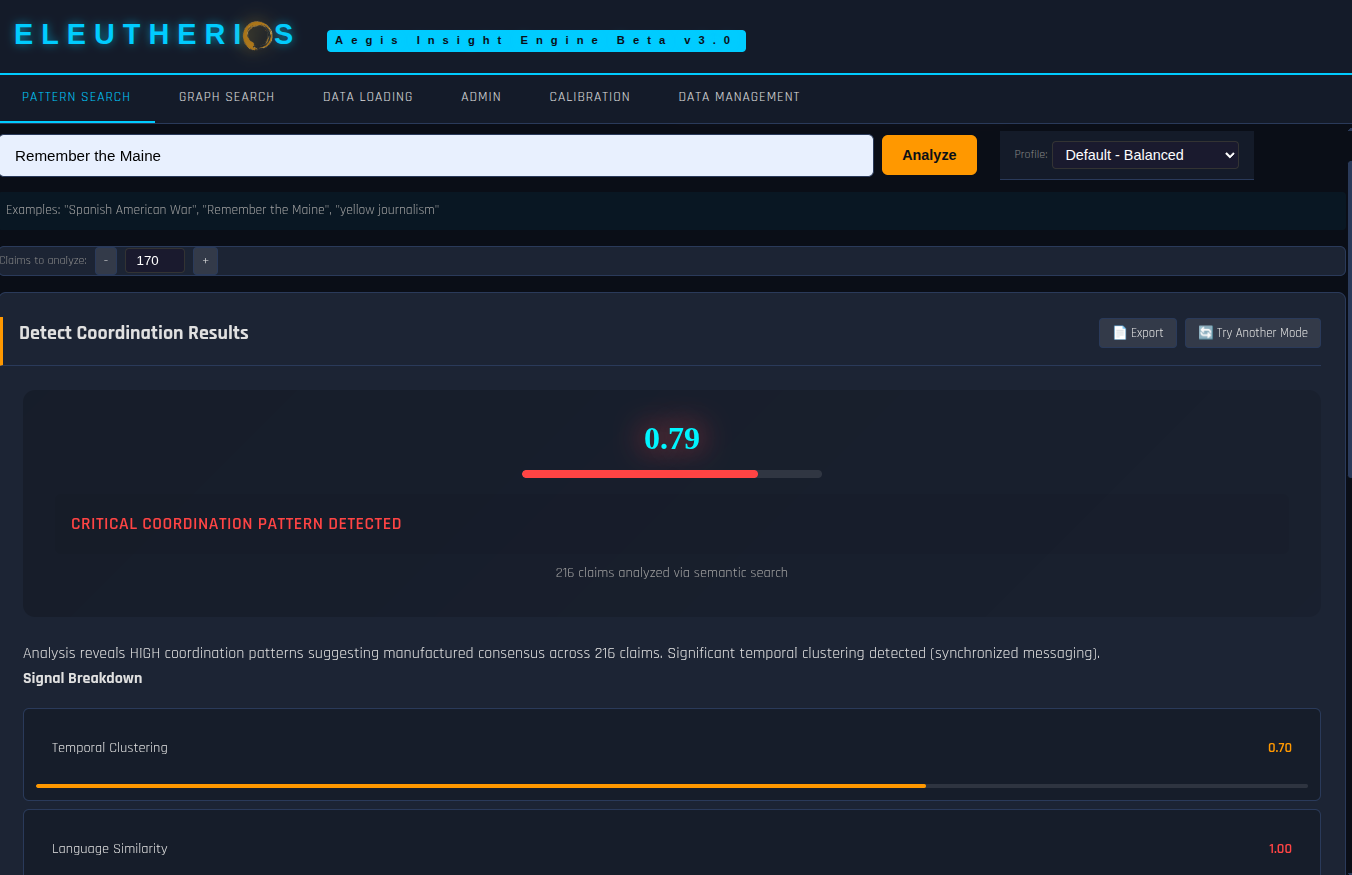
Semantic search with detection overlays. Find content and see its epistemic context simultaneously.
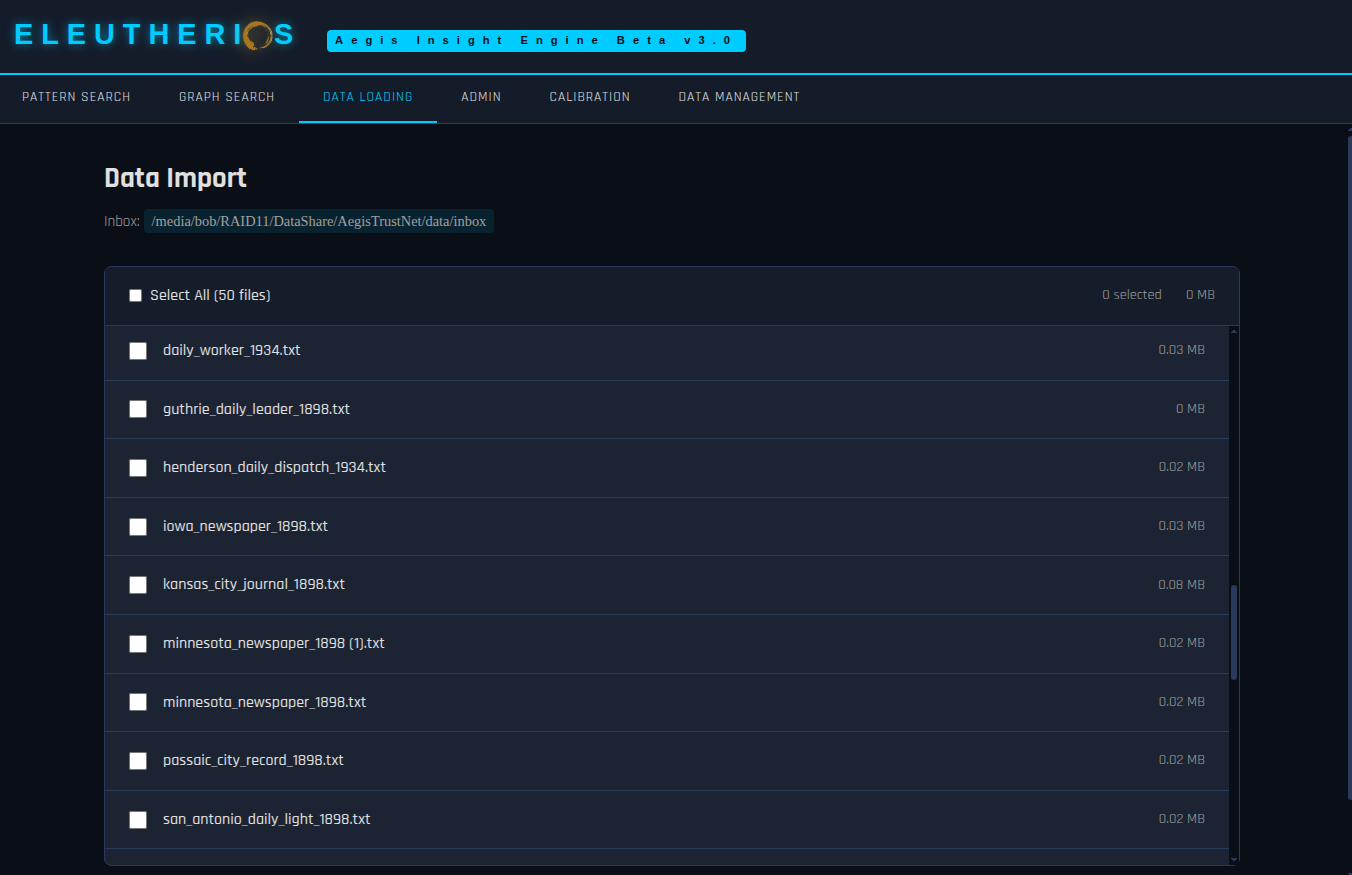
Wizard-driven ingestion for PDFs, text, and structured data. OCR to processed claim, entity, and metadata. Progress tracking and validation built in.
Configure detection profiles for different domains, or create your own. Tune thresholds based on your data set characteristics.
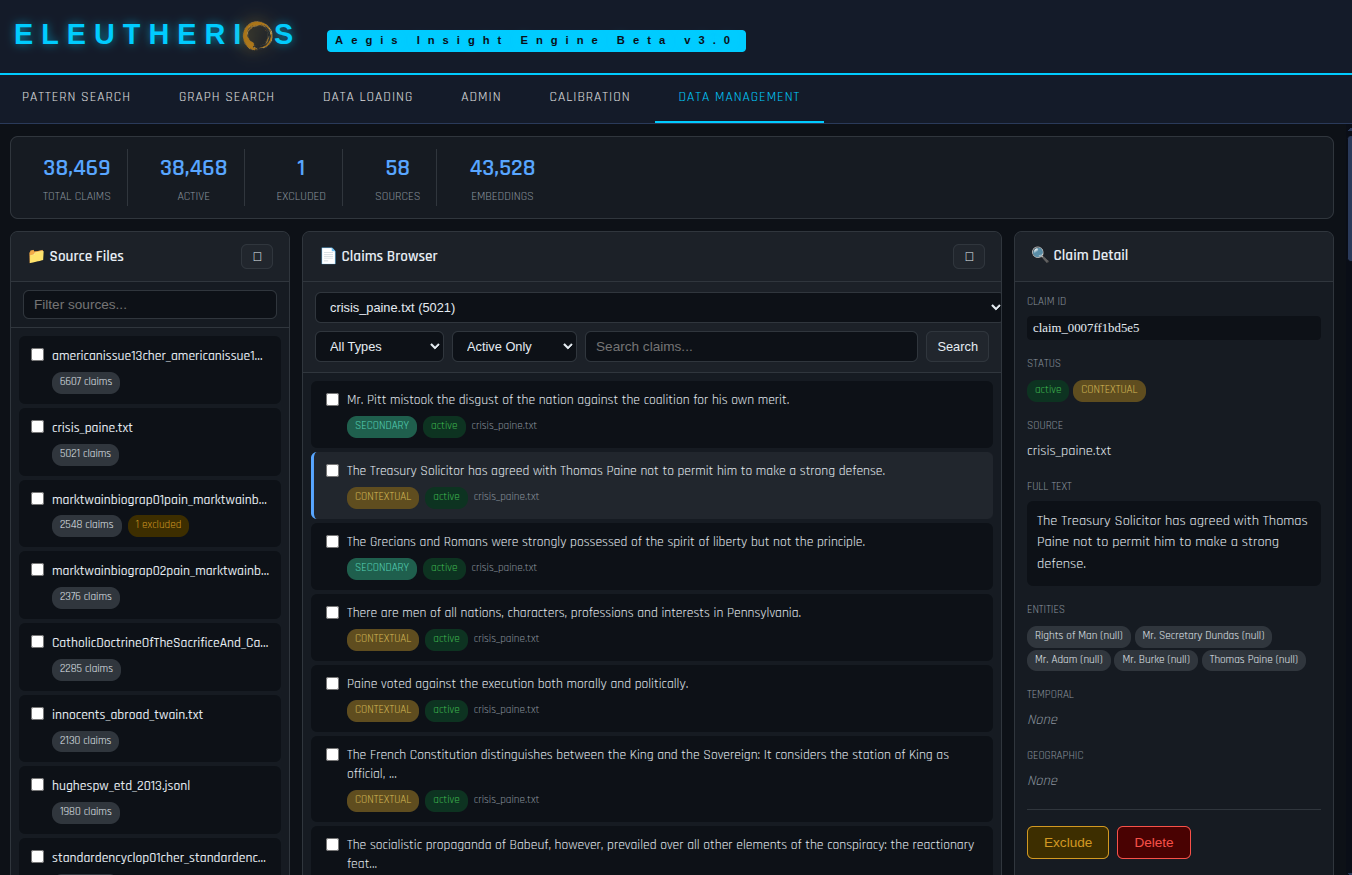
Manage source data files, respective claims, entities, linkages, purging discrete documents, and custom claim exclusions.
Standard, Coordination, Suppression, and Anomaly detection profiles provide rich analysis of entities, claims, and multi-dimension information topology.
The toolset is validated against settled history before you apply it to contemporary questions. These suppression scores come from a historical Americana demo dataset, cases where history has already rendered verdicts: Spanish American War, USS Maine, Thomas Paine, Smedley Butler, Prohibition, and more.
Aegis Insight—the analytical engine powering Eleutherios—provides epistemological context for RAG systems via MCP endpoints. Make your AI systems more resilient against data poisoning attacks and suppressed data manipulation attempts.
Detection algorithms identify coordinated manipulation attempts through temporal clustering, language similarity, and citation cartel analysis.
Surface marginalized-but-credible sources alongside mainstream positions. Expose credential inversion and evidence avoidance patterns.
Clean endpoints, Docker deployment, designed for your stack. Query suppression scores, coordination detection, and multi-perspective synthesis.
Load documents via the data wizard. PDFs, text, HTML—the system extracts and processes automatically. Ships with the Example American icon demo data set for immediate validation.
Local LLMs extract claims, entities, temporal markers, geographic references, citations, emotional framing, and authority domains from every chunk.
Neo4j stores the topology. Entities connect to claims. Sources connect to entities. Citation flows become visible. The structure emerges.
Suppression detection, coordination detection, anomaly detection—each with calibrated thresholds. Multiple weak signals combine into strong indicators.
An individual with a gaming laptop can now perform the same structural epistemological analysis that would have required a well-funded research team five years ago. Docker deployment, pre-populated demo data set, immediate capability.